
Naming and IP plan
Naming convention
Section titled “Naming convention”| Resource | Pattern | Example |
|---|---|---|
| Resource group | rg-<purpose>[-<suffix>] | rg-datacenter, rg-spoke, rg-hub, rg-management, rg-university-<suffix> |
| Virtual network | vnet-<role> | vnet-hub, vnet-datacenter, vnet-spoke |
| Subnet | snet-<purpose> | snet-servers, snet-app, snet-pe, snet-sqlmi |
| Bastion subnet | AzureBastionSubnet | Fixed name required by Azure |
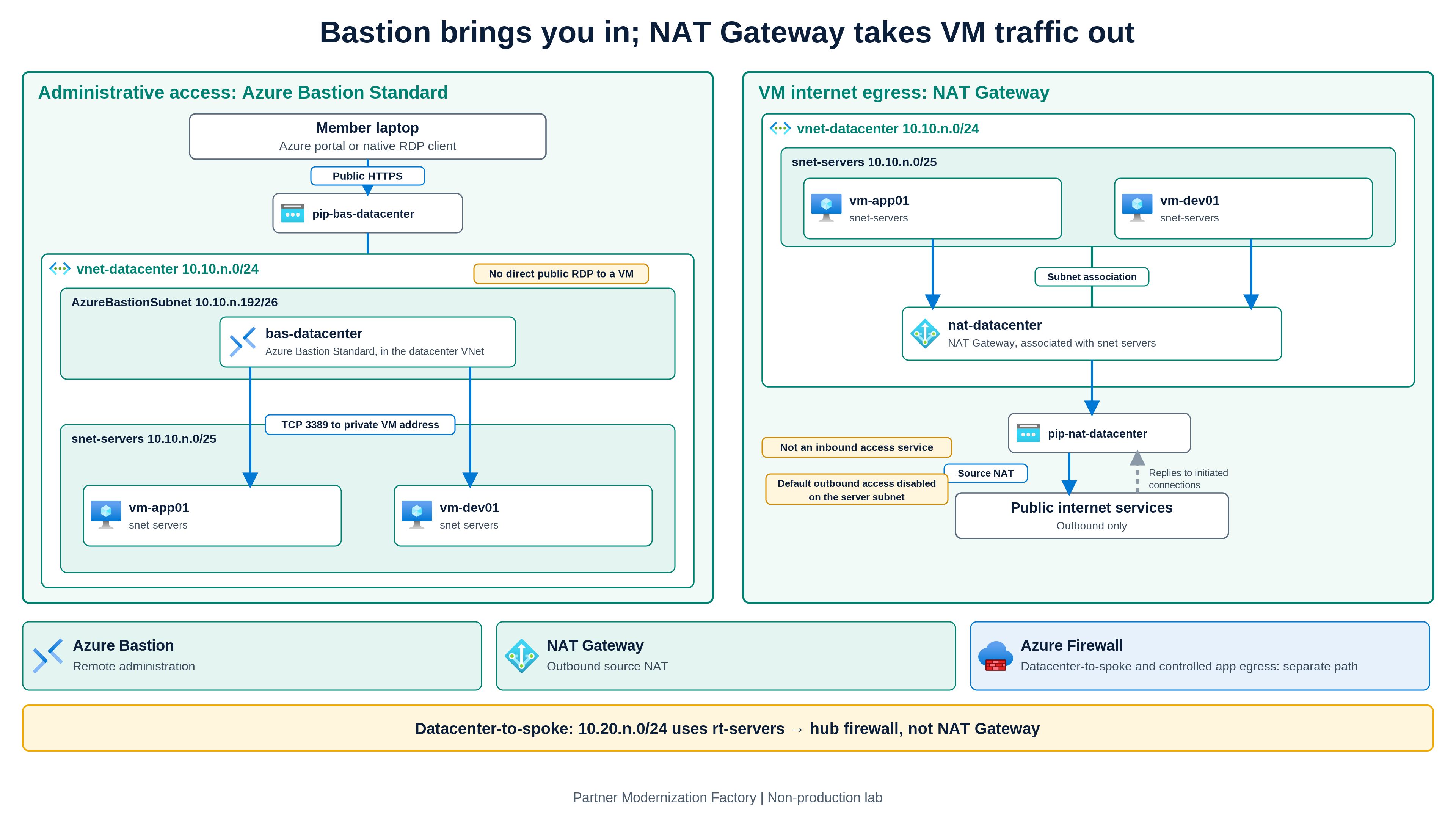
| Bastion | bas-datacenter | — |
| NAT gateway | nat-datacenter | — |
| Azure Firewall | afw-hub | — |
| Firewall policy | afwp-hub | — |
| User-assigned managed identity | id-<purpose> | id-sqlmi-directory |
| Log Analytics workspace | log-management | — |
| Firewall rule collection group (one per member) | rcg-member-<n> | rcg-member-3 in afwp-hub |
| App Service plan and web app | asp-university-<suffix>, app-university-<suffix> | C5 archetype |
| Container registry | cruniversity<suffix> | C5 archetype |
| SQL Managed Instance | sqlmi-university-<suffix> | C5 archetype |
| Storage account | stuniversity<suffix> | C5 archetype, container teaching-materials |
| Service Bus namespace | sbns-university-<suffix> | C5 archetype, queue notifications |
| Key Vault | kv-university-<suffix> | C5 archetype |
| Application Insights | appi-university-<suffix> | C5 archetype |
| Web app identity | id-university-<suffix> | C5 archetype |
| Management groups | mg-factory, mg-factory-platform, mg-factory-corp | Team hierarchy |
| Entra reader group | <mgPrefix>-readers | mg-factory-readers (assigned Reader at mg-factory) |
| Policy assignments | alzl-* | alzl-deny-pna-acr, alzl-dns-blob, alzl-diag-appservice |
| Public IPs | pip-nat-datacenter, pip-bas-datacenter, pip-afw-hub | Approved NAT, Bastion and firewall endpoints |
| Datacenter network security group | nsg-servers | Server subnet |
| Route tables | rt-app, rt-pe, rt-servers, rt-sqlmi | Spoke and datacenter routes |
| Workload budget | budget-factory-workload | Subscription-scoped |
| Pipeline resource group and identity | rg-cicd, id-factory-pipeline | Pipeline setup, T-14 |
| Virtual machines | vm-app01, vm-dev01 | Legacy source and private workstation |
Member index and suffix
Section titled “Member index and suffix”Two different values name member-scoped things. Both are saved in factory/.local/settings.json, and later pages show them as $s.memberIndex and $s.suffix:
- The member index
nis a positive whole number starting at1(with the team lead as1) that your team lead assigns. It sets your IP ranges and appears in names such asrcg-member-<n>, your firewall rule collection group in the hub. It is unique within a platform team. - The suffix is a random six-character string that
Initialize-Settings.ps1generates once and never changes. It names your archetype resources, for examplerg-university-<suffix>.
IP address plan
Section titled “IP address plan”For member index n, let b = floor(n / 256) and o3 = n % 256. Indexes 1 to 255 (b = 0) use 10.10.n.0/24 and 10.20.n.0/24; indexes 256 and higher (b >= 1) use non-overlapping /24 blocks in 10.128.0.0/10 (10.(127 + b).o3.0/24) for datacenters and 10.192.0.0/10 (10.(191 + b).o3.0/24) for spokes.
| Range | Purpose |
|---|---|
10.100.0.0/16 | Hub VNet (shared services subscription) |
10.100.0.0/26 | AzureFirewallSubnet inside the hub |
10.100.0.4 | Default hub firewall private IP; confirm the assigned address in its Overview |
10.10.n.0/24 (n = 1..255) | Member n’s datacenter VNet vnet-datacenter (workload subscription) |
10.10.n.0/25, .192/26 (n = 1..255) | snet-servers (vm-app01 at .4, vm-dev01 at .5) and AzureBastionSubnet inside the datacenter |
10.20.n.0/24 (n = 1..255) | Member n’s spoke VNet vnet-spoke (workload subscription) |
10.20.n.0/26, .64/26, .128/26 (n = 1..255) | Spoke subnets snet-app, snet-pe and snet-sqlmi |
10.(127 + floor(n/256)).(n%256).0/24 (n >= 256) | Overflow datacenter VNet pool inside 10.128.0.0/10 (snet-servers .0/25 with .4 and .5, AzureBastionSubnet .192/26; for example n = 256 uses 10.128.0.0/24) |
10.(191 + floor(n/256)).(n%256).0/24 (n >= 256) | Overflow spoke VNet pool inside 10.192.0.0/10 (snet-app .0/26, snet-pe .64/26, snet-sqlmi .128/26; for example n = 256 uses 10.192.0.0/24) |
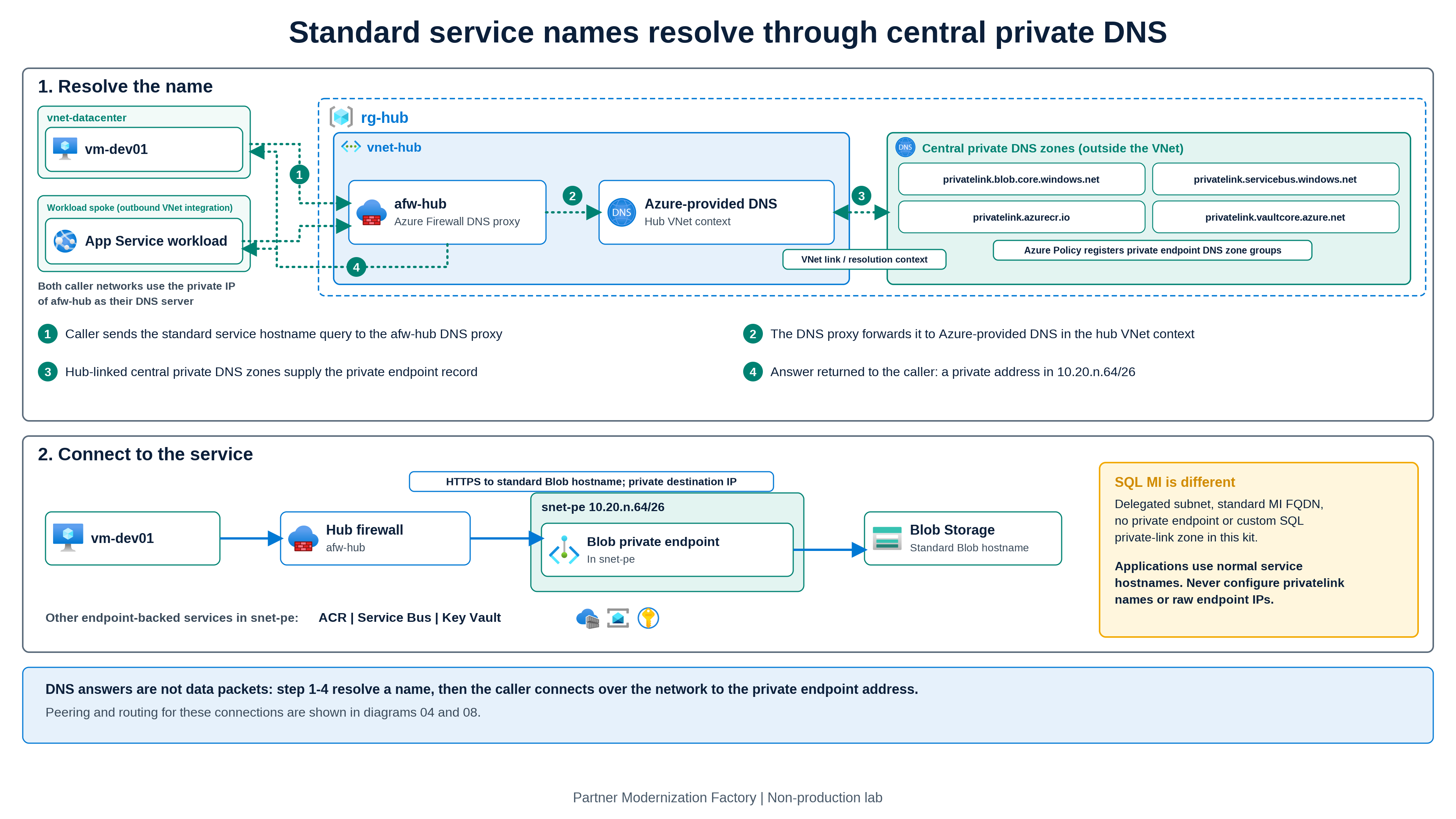
snet-servers belongs to the datacenter, not the spoke. The datacenter and the spoke aren’t peered with each other: traffic between them goes through the hub firewall. afwp-hub computes its SNAT private ranges dynamically so every member’s snet-pe (/26 at .64/26) is excluded and source-NATed for symmetric private-endpoint routing while MI link and management traffic retain their real source IPs.
snet-sqlmi has the network security group nsg-sqlmi and the route table rt-sqlmi. Vending creates both once, empty, and SQL MI’s network intent policy then adds its own rules and routes. Don’t redeploy them inline, because that would remove the MI’s rules. The kit adds its MI link rules as separate child resources.
How you reach the VMs and how they reach the internet
Bastion is the only way in to the datacenter VMs, and the NAT gateway only carries their outbound traffic. Traffic from the datacenter to the spoke doesn’t use the NAT gateway: it goes through the hub firewall.
How private names resolve
Your apps and VMs use the standard service host names. The hub firewall acts as the DNS server, and central private DNS zones answer with the private endpoint address. Never use privatelink names or IP addresses.
Where to go next
Section titled “Where to go next”See the glossary for the terms used here, or go back to Requirements.