
Event overview
The event runs over two days, with deployment work before day one. The customer story explains who you are working for and why. A team works through the day’s challenges in parallel where a challenge is scoped to a member, and together where it’s scoped to the team.
Before the event
Section titled “Before the event”Before day one, your team sets up the repositories, the shared landing zone, and each member’s simulated datacenter. No coach is available during the pre-hackathon, and pre-hackathon support is best-effort. Your designated team lead is your first point of contact.
The kit supports two pre-event setup paths:
- Path A — Self-service teams (Deploy): each member creates their own private repository and runs their own preflight and datacenter stages across Steps 1 to 4 below.
- Path B — Lead-provisioned cohort (Lead-provisioned setup): one platform team lead creates the student repositories (
Initialize-CohortRepos.ps1), deploys the shared foundation, deploys every student’s datacenter and runs spoke vending from the lead repository. Attendees share their GitHub username privately, accept their repository invitation, and complete Student onboarding. Large cohorts (n > 5) split into 3-to-5-person breakout pods for the team challenges (C1, C4 and C10), each with a nominated pod lead.
In Path A (Self-service teams), the dates count back from day one and the steps in Deploy follow the exact chronological order below:
- Step 1: Repo and preflight (T-14) (Everyone + Team lead): meet the requirements, create your private repo from
apex-accelerator, import the kit intofactory/, sign in, and create.local/settings.json. Members send their four roster values privately to the team lead and set up the member pipeline; the team lead builds.local/roster.jsonand sets up the lead pipeline. Everyone runs thewhatifpreflight and completes the manual checks. - Step 2: Foundation and Graph grant (T-7) (Team lead + Privileged Role Administrator): an authorized Entra operator bootstraps
<mgPrefix>-readers(Sync-FactoryReaderGroup.ps1), then the team lead runs thefoundationstage to deploy ALZ-lite in the shared services subscription. A Privileged Role Administrator then runsGrant-SqlMiDirectoryRead.ps1once for the team. Members have nothing to run at T-7. - Step 3: Datacenter and workstation (T-3) (Everyone): every member (including the team lead) runs the
memberstage to deploy their datacenter, runTest-Datacenter.ps1while both VMs are running, and onboardvm-app01to Azure Arc. The test runs before Arc because Arc turns off VM run commands. You then run the first Arc SQL migration assessment in the portal, set upvm-dev01with VS Code and GitHub Copilot, and commitfactory/evidence/readiness/. - Step 4: Vending (T-1) (Team lead + Everyone): every member makes sure both datacenter VMs are running. The group owner syncs
<mgPrefix>-readersfrom the full roster, and the team lead runs thevendingstage, which checks datacenter and Arc readiness, vends each spoke into the foundation, restarts the VMs, records the datacenter policy exemptions, and runs the connectivity probes.
T-14 and T-3 are the readiness milestones for members. At T-1, vending stops at the first member whose datacenter or Arc connection is not ready: earlier members are vended but not restarted, exempted or probed, and later members are not vended. Fix the cause and re-run vending for all members; it is safe to repeat. If phase 2 fails while restarting VMs, fix the cause and re-run for all members. If phase 3 names members whose exemptions or connectivity probes failed, re-run for those named indexes only. Raise blockers with your team lead early. The readiness check is a prerequisite, not a challenge.
The times are the event plan; coaches may adjust them. Challenge time boxes are pacing guides, not hard stops.
| Time | Activity |
|---|---|
| 08:30–09:00 | Kickoff presentation (scenario, roles, challenges) and roster lock |
| 09:00–09:45 | C1: Define the opportunity |
| 09:45–10:30 | C2: Secure, AI-ready foundation |
| 10:30–11:30 | C3: Assess the source |
| 11:30–12:15 | C4: Choose target states |
| 12:15–13:15 | Lunch break |
| 13:15–13:45 | APEX archetype demo |
| 13:45–14:45 | C5: Deploy the CoE archetype |
| 14:45–16:15 | C6: Modernize with GitHub Copilot, part 1 |
| 16:15–16:30 | Break |
| 16:30–16:45 | Day 1 check-out and evidence capture |
Day one opens at 08:30 with a 30-minute presentation by the tech lead introducing the hackathon, the Contoso University scenario, the target architecture, and the 10 challenges. Slides or a short recording compare a full Azure Landing Zone with ALZ-lite; there is no separate live ALZ demo.
At 09:00, everyone starts C1: Define the opportunity, the team lead included. C1 needs no Azure access. Next, in C2: Secure, AI-ready foundation, each member tests an AI coding agent against two layers of guardrails: APEX’s repository security baseline and the Azure Landing Zone Deny policies in rg-spoke.
Members then assess the source in C3, choose target states in C4, watch the coach’s APEX demo and deploy the archetype in C5. C6: Modernize with GitHub Copilot starts on day one and finishes on day two.
| Time | Activity |
|---|---|
| 08:30–09:00 | Reconnect, check both VMs and the Graph grant, then start the MI link |
| 09:00–10:30 | C6: Modernize with GitHub Copilot, part 2 |
| 10:30–12:30 | C7: Migrate and go live |
| 12:30–13:15 | Lunch break |
| 13:15–14:00 | C8: Validate the pattern |
| 14:00–15:00 | C9: Optimize the database with GitHub Copilot |
| 15:00–15:15 | Break |
| 15:15–16:15 | C10: Package, hand over and review AI readiness |
| 16:15–17:00 | Showcase and close |
The MI link starts at 08:30 through requirements 1 and 2 of C7, so seeding overlaps the end of C6. C6 finishes, then C7, C8, C9: Optimize the DB with GitHub Copilot and C10 finish the event before the team showcase.
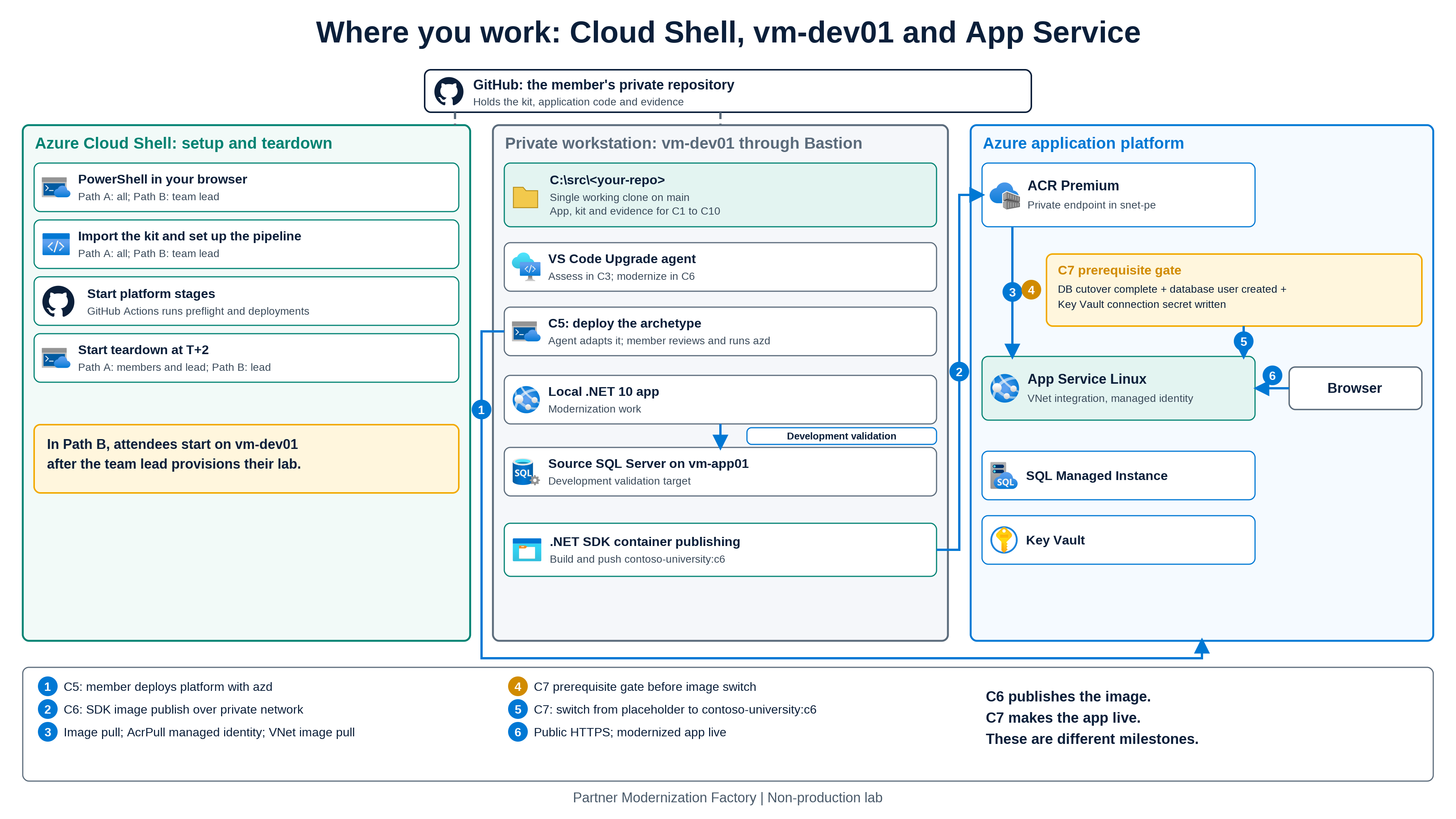
Time boxes are pacing, not hard stops
Section titled “Time boxes are pacing, not hard stops”Each challenge page states a time box to help you pace the day. The real gates are T-14 and T-3 before the event and the end of each day during it, not each challenge’s individual minutes.
Read Roles, then Requirements. The glossary explains the terms.
After the event (T+2)
Section titled “After the event (T+2)”Save and push your work before Tear down (Path A) or Tear down: Lead-provisioned cohort (Path B). Every member scope is removed before the shared foundation, and a named admin removes each pipeline identity and its roles.